
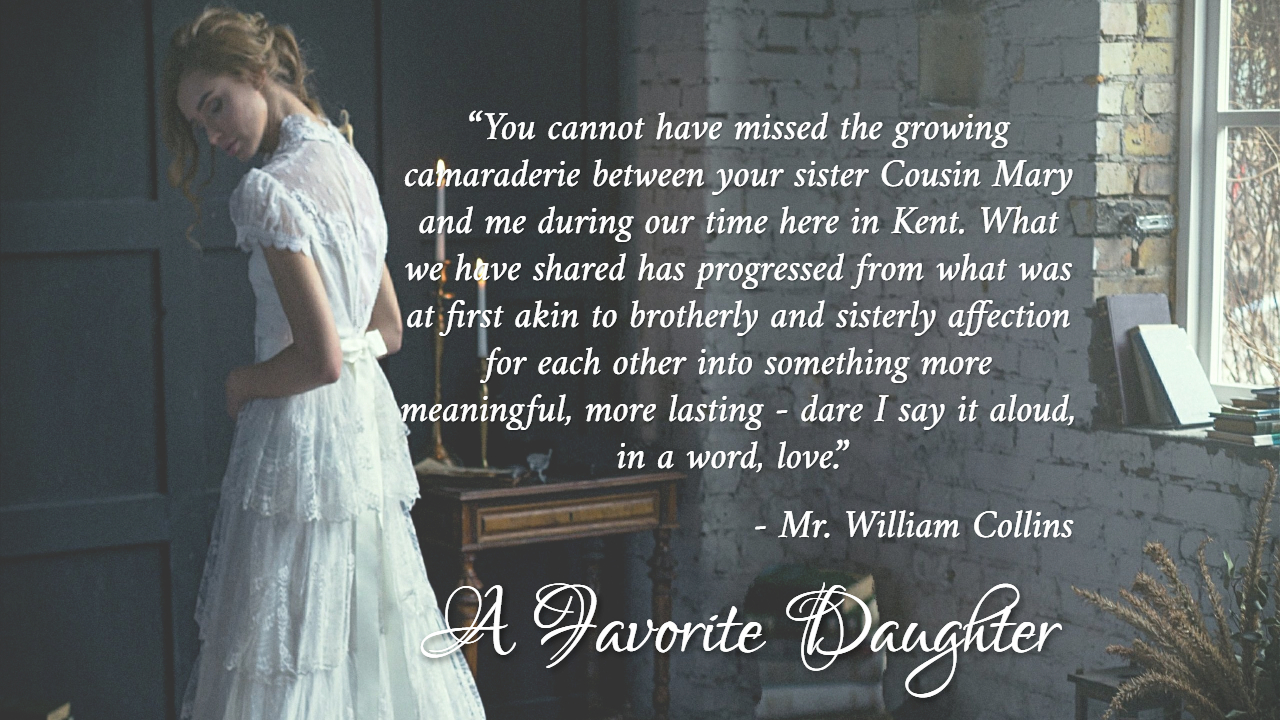
Did you know my bestselling historical romance story, A Favorite Daughter, features a pairing between two side characters whom Jane Austen fan fiction lovers often speculate about marrying each other? The couple in question is Mr. Collins and Miss Mary Bennet.
The recent release of A Favorite Daughter as an audiobook has indeed breathed new life into the story. When I decided to expand my audiobook catalog to include a male narrator, I was confident Benjamin Fife would do a brilliant job. And indeed, he exceeded my expectations. His rendition of Mr. Darcy had me falling in love with the character all over again every time Mr. Darcy spoke, which was quite often indeed. But I digress.
The point of this post is to give Mr. Collins his proper due. Several audiobook listeners, including Mr. Fife, remarked on what a stand-up gentleman Mr. Collins is in A Favorite Daughter (words to that effect). I could not have been more pleased with the response. I always knew he had it in him.
Indeed, the comments reminded me of a post I shared on Austen Authors, In Want of a Hero, exactly seven years ago in March 2017.
Here’s how it read:
“A man would always wish to give a woman a better home than the one he takes her from; and he who can do it, where there is no doubt of her regard, must, I think, be the happiest of mortals.”
When I came across it in my quest to find the perfect quote to reflect the theme of my story, Miss Elizabeth Bennet, I believe I only thought of Mr. Darcy and Elizabeth and their journey to happy ever after.
Upon later reflection, however, I find that I can also imagine Mr. Collins thinking those exact sentiments. He did, after all, propose to Elizabeth with absolutely no doubt of a favorable reply.
While Mr. Collins does not immediately come to my mind when I think of dashing heroes, I must admit that I adore this line:
“And now nothing remains for me but to assure you in the most animated language of the violence of my affection.”
Admit it. Is such a line not absolutely swoon worthy? Couldn’t Darcy have just as well uttered words of a strikingly similar vein during his initial proposal in Hunsford?
As for doubting Elizabeth’s regard, Collins, despite repeated rebuttals from the lady whom he had singled you out as the companion of his future life almost as soon as he made her acquaintance, had this to say:
“You must give me leave to flatter myself, my dear cousin, that your refusal of my addresses is merely words of course. My reasons for believing it are briefly these: It does not appear to me that my hand is unworthy of your acceptance, or that the establishment I can offer would be any other than highly desirable.”
No doubt, Mr. Collins thought very highly of himself and all he had to offer his fair cousin. And why wouldn’t he?
How can anyone help but admire the gentleman’s persistence?
“When I do myself the honor of speaking to you next on the subject, I shall hope to receive a more favorable answer than you have now given me; though I am far from accusing you of cruelty at present, because I know it to be the established custom of your sex to reject a man on the first application, and perhaps you have even now said as much to encourage my suit as would be consistent with the true delicacy of the female character.”
I know. I know. Elizabeth was not having any of it.
To such perseverance in wilful self-deception Elizabeth would make no reply, and immediately and in silence withdrew; determined, if he persisted in considering her repeated refusals as flattering encouragement, to apply to her father, whose negative might be uttered in such a manner as to be decisive, and whose behavior at least could not be mistaken for the affectation and coquetry of an elegant female.
Poor Mr. Collins. Happily deceived into thinking his efforts in pressing his suit had met with success and thereby willing to repeat his proposal a second, or even a third time if that is what it would take, the gentleman’s subsequent talk with Mrs. Bennet finally helped put things into proper perspective.
“Pardon me for interrupting you, madam,” cried Mr. Collins, “but if she is really headstrong and foolish, I know not whether she would altogether be a very desirable wife to a man in my situation, who naturally looks for happiness in the marriage state. If therefore she actually persists in rejecting my suit, perhaps it were better not to force her into accepting me, because if liable to such defects of temper, she could not contribute much to my felicity.”
Which brings me back to the beginning, applying Austen’s quote to Mr. Collins:
“… and he who can do it, where there is no doubt of her regard, must, I think, be the happiest of mortals.”
A man who knows what’s really important to him—an admirable quality indeed.
Perhaps Mr. Collins is hero-making material after all. To his way of thinking, he surely swept Miss Charlotte Lucas off her feet. One can only imagine the manner of animated language he chose to press his suit so successfully the second time around. Hmm?
Another possible Pride and Prejudice variation? We’ll see.
Now that I think of it, perhaps A Favorite Daughter turned out to be that sort of variation after all.
Listen to A Favorite Daughter for free.
Also available where audiobooks are sold. Click here now!
A Favorite Daughter is available in eBook, paperback, and hardcover. Click for more…

Happy News!
A Favorite Daughter will be part of a BookBub International Deal beginning March 10, 2024.
Mark your calendar to grab it for only 99 cents!


Leave a Reply