
I belong to a Facebook Group called Regency Kisses: Lady Catherine’s Salon. Many of those found on the group are authors of Regencies novels (but not necessarily authors of Jane Austen Fan Fiction novels). These are often people who have studied and written in the Regency era exclusively. They are NOT those who learn everything about the Regency by watching a miniseries.
Recently, Nancy Mayer, who likely owns a full Regency library in her home, placed a post or two up, and I asked if I could share them here. These are Regency facts, NOT myths. Read on . . .
These are bits one might find in the novels, beloved by readers, that just were not a part of Regency life.
This first list is on marriages, engagements, etc., and the announcement thereof.
Though marriages were reported in the newspapers, engagements were NOT, that is unless one was Princess Charlotte. I repeat: Announcing an engagement in the newspapers is a popular plot point in romance novels (even used by Georgette Heyer in “The Grand Sophy”, but it was not something that happened in real life.
(Just to keep Jane Austen in the conversation, we find this quote from Chapter 53 as an example: “And one of my own daughters. I suppose you have heard of it; indeed, you must have seen it in the papers. It was in the Times and the Courier, I know; though it was not put in as it ought to be. It was only said, ‘Lately, George Wickham Esq., to Miss Lydia Bennet,’ without there being a syllable said of her father, or the place where she lived, or anything. It was my brother Gardiner’s drawing up too, and I wonder how he came to make such an awkward business of it. Did you see it?”
A country weekly might mention a betrothal if it involved the local peer or his heir or his daughter, but it would be a part of the Society news.
Many newspapers had a small section where births, marriages, and deaths were reported, as well as a section for mentioning the balls and dinners the aristocrats were holding.
More information about local people would be reported in the country weeklies, but usually, it still was balls, dinners, and routs with small notices of births, deaths, and marriages.
The Hardwicke Act was only law in England and Wales. It was not the law in Scotland or Ireland or any of the English colonies.
This act was meant to make marriages more public and regular. Though people had always been encouraged to have the banns called, it now became a requirement that they do so unless the couple obtained a license from the local bishop or the Archbishop of Canterbury. By 1811, the cost of a special license was £5. It was mostly used by the aristocracy and men in the public eye. The standard license from a bishop required a bond for £100 to be forfeit if the couple lied about any allegation as well as a slight fee. This license named the parish in which the wedding would be held. (Not transferrable) This license entailed a wait of seven days. The couple still had to marry between the hours of eight and noon.
Catholic couples in Ireland could be married by a Catholic priest without the banns being called, though the church preferred that the banns be read. A Protestant marrying a Catholic had to be married by a Protestant clergyman. This remained the law for most of the 19th century.
By law the Roman Catholics were supposed to be married first by an Anglican priest before marrying by Catholic rites, but in practice many married in Catholic rites first. [Note: I used this as a plot device in my REALM series, A Touch of Honor (Book 7)]. However, the marriage was not valid until and unless they married according to the law, by a clergyman of the Church of England. For an aristocrat, that could mean his children would be considered illegitimate if he is not married in an Anglican ceremony. [Aha! Now that is where my plot device comes in!]

As the majority of the marriages were by banns, everyone in the parish would hear the banns read for three Sundays. Even if one rarely attended church, word would spread that a couple was planning to marry.
Those who married by regular license had to marry in the parish church between the hours of eight in the morning and noon. Usually, friends, family, and neighbors knew about the upcoming wedding.
Some plots used by novelists were contrary to the laws.
For example, all marriages had to be registered in the parish register even if the couple married in a private house by special license.
Usually, the couple signed the register with their witnesses before leaving the church.
Marriage contracts were no longer enforced. It was an offense against church law for a clergyman to marry anyone who was not a willing participant in the ceremony. [This will be part of my upcoming The Marchioness’s Madness. I am still writing this one, but I am nearly finished.]
Do not believe a story that says a marriage of convenience could be annulled in a year if it was not consummated. Along the same line is the idea that a couple could have a marriage for a year, and if no child was born, they could go their separate ways and marry others. That was not even possible in Scotland, which still permitted a divorce under specific circumstances.
A couple in England would not be married just because they told someone they were. In England, specific things had to occur before a marriage was legal. A couple in Scotland who meant it and had sexual intercourse after saying so, would, however, be married.
Captains of ships were not authorized to perform weddings. No captain of a ship could marry people.
There were no provisions in the law for proxy marriages anywhere in the British Isles. If a marriage by proxy took place in a country or countries where they were permitted, then such a marriage would be valid in England. None of the cases which came before the courts involved men or women who had been born and baptized in England. [Again, I used this as a plot point in my novel, Amending the Shades of Pemberley. How did I manage to marry Elizabeth (in England) and Darcy (in India)? One must read the book to learn how I managed that one.

Any marriage of a minor who married by license without the permission of the father or guardian was not valid.
Annulments were only granted for a few specific reasons such as insanity, bigamy, incest, not being of age, and impotence. The marriages of minors who married by license without permission were never valid, but the couple often could have the court annul it, so they would have a record of the action. If any children had been born, the children were illegitimate. One hopes none of them also married by license thinking they had the proper permission.
Consummation was NOT a requirement for a valid marriage in England, though the Scots did consider it so. The inability to consummate a marriage due to impotence or a physical malformation was cause for an annulment. The court usually wanted the couple claiming impotence to be married for some time to see if the condition reversed itself.
A couple could be married in Scotland by saying they were so and having sexual intercourse, but not in England. Marriage in England needed a license or banns and an ordained clergyman of the Church of England unless the couple marrying were Jewish or Quakers.
Marriages in England had to be conducted by an ordained clergyman of the Church of England unless the bride and groom were both Jews or Quakers.
Okay, hold onto your hats for this one: There was no “You may kiss the bride” line in the church ceremony! The couple sometimes kissed when they signed the register which was part of the ceremony, though the register was in a different room. The marriage ceremony was as written in the Book of Common Prayer. No double ring ceremonies, no special words, and no KISS THE BRIDE. Some bishops did complain about couples kissing at the end of the ceremony, so I think it had to have happened sometime, but it was not a part of the service.

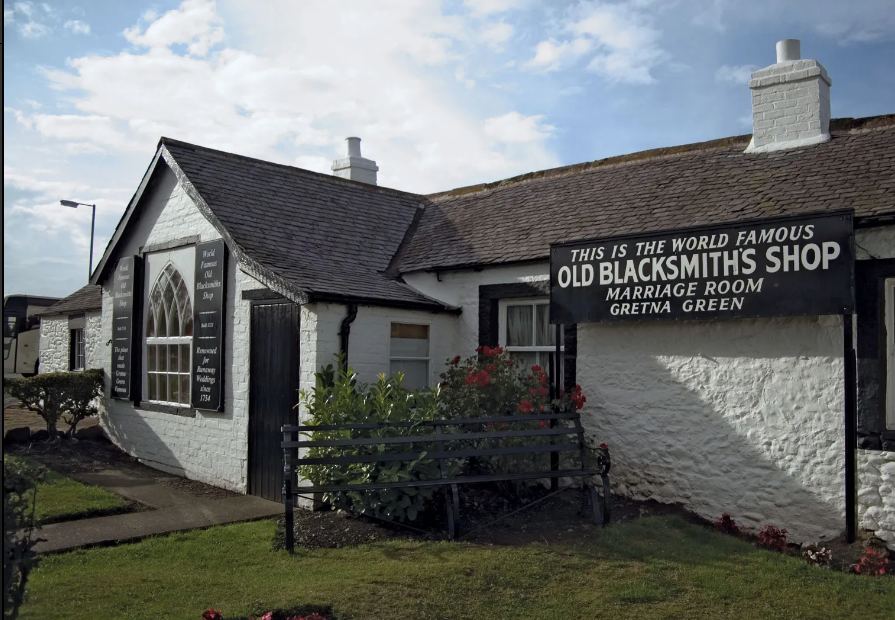
Gretna Green was one of the nearest Scottish towns where marriages could be conducted, and, therefore, it was quite popular. However, do not forget how long it would take for the hero and heroine to travel from London to Scotland by coach, at say 7-10 miles per hour, not counting all the stops for tolls, etc. Gretna was one of the nearest, and made quite a business of it. BUT IT WAS NOT THE ONLY PLACE TO MARRY IN SCOTLAND. I have used numerous Scottish towns/villages along the border for several of my plot points. Also, remember, since it took several days to travel that far, the girl would be “ruined,” but if the couple could be caught in time, the matter could be hushed up.
Dissolving a marriage
“A marriage could be dissolved by death, annulment, or divorce.
“Annulments were not easy. One couldn’t just decide to marry and get an annulment in a year for either the marriage was valid or it wasn’t. If it wasn’t valid the couple were never married, and if the marriage is valid they can’t get it annulled.
“Marriages were null and void if minors married by license without the proper permission, if either of the couple had a living spouse, or if either was considered too young to marry. Shocking to our sensibilities, the age which was considered too young was before age seven. Children could be married off between the ages of seven and twelve, if female, and seven to fourteen, if male. However, when the female reached the age of twelve or the male reached the age of fourteen, the child could repudiate the marriage or decide to stay with it.
“Fortunately, by the late eighteenth century, public opinion shifted so that most people disapproved of marrying children off at such tender ages. By the beginning of the nineteenth century, the attitude had shifted to allowing girls to wait until they were seventeen or older before declaring them of an age to marry. Despite tales of girls being considered on the shelf if not married by age nineteen, quite a few Regency young ladies didn’t marry until they were twenty or even older.
“Marriages were also void if one of the couple did not have a proper understanding of what he or she was doing. The church insisted on willing and informed consent, or at least as much informed consent as might be expected of a twelve year old girl.
“Marriages could be annulled if one of the couple, usually the male, was impotent.
“Marriages did not have to be consummated in England to be valid. The ability to consummate had to be present.”
For more information on marriage or the Regency, in general, check out Nancy Regency Researcher.
This was so much fun, I think I will continue with a few more of these types of posts. Let me know what you think.
If you are looking for a resource to aid in either your writing or your reading, I might suggest Writing Regency England: A Resource for Authors by Jayne Davis and Gail Eastwood.

From pitfalls to perfection – your essential Regency writing companion
Are you writing stories set in Regency England? Do you want your characters and settings to feel authentic? Then this is the book to help you escape common pitfalls and breathe authenticity into your writing.
Writing Regency England is the only guidebook tailored specifically to help you to avoid the most commonly seen errors in Regency fiction. All historical authors face the challenge of not having lived during the time they are describing, and also share the problem of “you don’t know what you don’t know.” No one gets everything right! But non-British authors writing about England also have the disadvantage of not being steeped in the language, geography, culture and history of the country from living there. While some readers don’t care about accuracy as long as a story is good, others do and if you get too many things wrong, they may leave bad reviews and put you on their ‘authors to avoid’ list.
British author Jayne Davis and American author Gail Eastwood combine their perspectives and meticulous research to offer invaluable insights into language, setting, and society. This indispensable guide illuminates common pitfalls but also can spark creative ideas rooted in the authentic details of Regency life and offers a great starting point for further research.
The book covers:
Part 1: Language
The value of historical flavor and period-appropriate language, and research tips; tables listing American or anachronistic words to avoid in many categories; aspects of character voices including class and speech, grammar, word choice, and variations by location; a look at period given names (including minority groups) with ways to create authentic variety, creating or finding appropriate surnames, and valuable advice on title names.
Part 2: Setting
Flora and fauna found (and not found) in the UK, with tips on using them in your story, including animals, insects, birds, wild plants and garden plants; landscapes of Britain including general topography, varied inland and coastal landscapes, and how weather factors in and affects these; the “built” landscape including building styles and materials, transport, and historical structures; advice on naming places and features, plus a chapter on travel covering both land and sea journeys, examining the factors affecting these, plus maps, guidebooks, and how long journeys took.
Part 3: Society
Easily a book unto itself, this sections covers: money and incomes, different branches of the military, the peerage, courtesy titles, forms of address, precedence and privileges of rank; inheritance and entails, guardianship, plus inheritance of titles; a thorough examination of marriage in multiple aspects, as well as ending marriages; a few selected social activities (letters, the postal system and dancing), and finally, hunting, shooting, and weapons (including military).


Leave a Reply to Regina JeffersCancel reply