
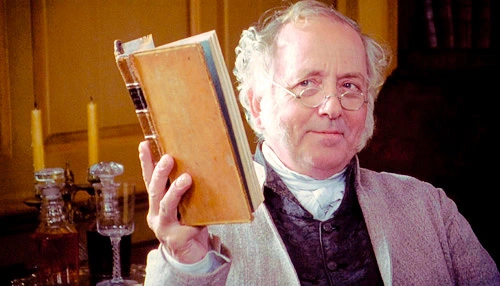
Analyzing Mr. Bennet
Although my first thought for this post was to put one of Mr. Bennet’s quotes at the very beginning, I thought of something better. A question: Why did Jane Austen not give Mr. Bennet a first name? She did so for just about every other character in Pride and Prejudice. Did she find him that unimportant to the plot or did she just not like him? Admittedly, he did have some bad character flaws such as indolence, sarcastic nature, and sneering attitude toward his fellow man. Did he not have at least a few redeeming qualities that we could be pleased with? Perhaps.
If we take a look at his comments to some of the events in the book, it might give us a little insight into his personality.
I love the following quotes:
Mrs. Bennet – “You take delight in vexing me. You have no compassion on my poor nerves.”
Mr. Bennet – “You mistake me, my dear. I have a high respect for your nerves. They are my old friends. I have heard you mention them with consideration these twenty years at least.”
This one is definitely my favorite of the entire book. It is his response to Mrs. Bennet when she insists he make Elizabeth marry Mr. Collins.

“An unhappy alternative is before you, Elizabeth. From this day you must be a stranger to one of your parents. Your mother will never see you again if you do not marry Mr. Collins, and I will never see you again if you do.”
Does he take delight in vexing his wife? One does wonder when he seems to take little verbal pokes at her. Or, perhaps, he’s trying to subtly make a point, but Mrs. Bennet is not sharp enough in intellect to understand what he’s doing. He’s never openly abusive to his wife: verbally or physically. Has he just given up in encouraging his wife to moderate her reactions to circumstances? Certainly, if she learned to be less effusive or emotional over matters, her nerves might not suffer so. I can sympathize with him concerning her loud exclamations that could be very embarrassing on occasion, when in public, but his efforts to curb her enthusiasm down through the years had apparently been for naught. I wonder how long it took before he just gave up and began hiding in his library.

Or did he even try? Possibly not. After all, his estate doesn’t seem to be producing at full capacity, and Austen gave the impression 2,000 pounds per year was not that much income in light of five children, a wife, servants, and himself to care for. She also indicated that he preferred his library to doing much else. And we don’t read of him visiting tenants, riding the property looking for problems, or spending time with ledgers for Longbourn. Most of the time, he is ensconced with his books.
Mr. Bennet’s joking manner wasn’t reserved just for conversations; it also was applied in print. For example, Bennet’s comments in his letter to Mr. Collins concerning Elizabeth and Darcy’s forthcoming marriage depict wit and wisdom.
“I must trouble you once more for congratulations. Elizabeth will soon be the wife of Mr. Darcy. Console Lady Catherine as well as you can. But, if I were you, I would stand by the nephew. He has more to give.
The man was not an idiot. He was well read and well educated. Is it possible he just got caught up in trying to improve himself? Or was he putting forth effort to understand his fellow man better and simply gave up after a while? 😊 Probably not. More likely, he could only tolerate his wife (or family) for a short while before he lost patience, and he removed himself to his library before he lost his temper. Viewed in that light, he may be a better guy than he comes off being in Austen’s book.

Then again, the book is called Pride and Prejudice, and, perhaps, Mr. Bennet is too proud to admit he made a mistake in marrying Mrs. Bennet nee Gardiner. But, then again, if he hadn’t, they would not have their daughters including Elizabeth.
Ah, Elizabeth. She definitely is her father’s favorite offspring as their personalities are very similar…to Elizabeth’s benefit and her detriment. Spending time with her father has not only given her the opportunity to develop her intellect, it has also given her time to pick up some of Mr. Bennet’s less pleasant traits such as barbed comments and not tolerating the foolish aspects of others’ personalities. After all, most of us do have some foolishness inherent in us though other good qualities may overshadow that less desirable trait. However, Elizabeth’s father’s attitude is depicted in the following quote.
“For what do we live, but to make sport for our neighbors, and laugh at them in our turn.”
Even if Mr. Bennet is a ‘good guy,’ I wouldn’t want him looking to me with a possible opportunity of getting a smile or a good laugh at my expense whether I knew it or not. It’s doesn’t seem kind to me. Another instance of being a bit unkind is found at the beginning of the book when Mr. Bennet hides the fact that he has already visited Mr. Bingley, and he gives his wife the runaround as to that incident leading to the opening quote of this post concerning her nerves. Mrs. Bennet’s nerves might not have been half so bad if her husband hadn’t given her little verbal pokes and prods fairly frequently. Not very kind of him.

He was just teasing, you say? I admit that teasing someone can be fun, but one has to be careful when teasing that it doesn’t become hurtful. Comments with barbs imbedded can hurt if taken too far, and Mr. Bennet, as well as his favorite daughter, were probably guilty of that very thing on too many occasions though Elizabeth less so. And Mr. Bennet never seems to wake up to the fact that his wife’s worry and nerves concerning being thrown into the hedgerows when he dies are all due to his indolence in not really working his estate and not saving toward his daughter’s dowries. He may have been delivering payback to his wife for disappointing him by not being the wife he thought he married, but in doing so, he hurt his entire family. He’s a smart man, but he missed the boat entirely when it came to his lack of responsibility and the problems it caused.
Now, was he totally irresponsible? No, because he did hie off to London to search for Lydia and Wickham when he acknowledged his poor decision to allow his youngest daughter to go to Brighton with the Forsters. I imagine his lack of discipline of Lydia and his poor judgment, in this case, was quite an eye-opener for him. But did it encourage Bennet to make major changes in his life? Apparently not. Every future occurrence seems imbodied in this quote.
“I admire all my three sons-in-law highly,” said he. “Wickham, perhaps, is my favorite: but I think I shall like your husband quite as well as Jane’s.”
How could he say that Wickham was his favorite? Because it was all still a joke to him.
Jane Austen never lets us know if Mr. Bennet changed in essentials or for the better. The last mention of him indicated him missing Elizabeth exceedingly and delighting in going to Pemberley when he was least expected. Now, wasn’t that a little rude of him to just ‘show up’ without alerting them he was coming? Of course, it was. But Mr. Bennet was just being Bennet and getting a laugh or a smile out of every occasion. Personally, I don’t think Austen liked or respected this character. What do you think? Let me know in your comments below. 😊


Leave a Reply to Gianna ThomasCancel reply