
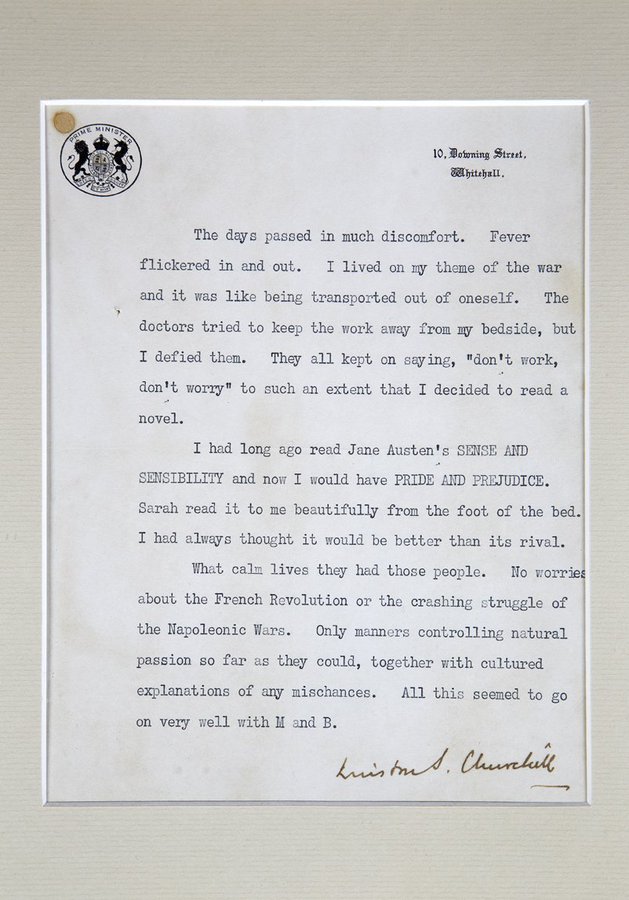
Nearly eighty years after the end of World War II, it is fitting to remember that Britain’s bulldog leader once benefitted from the soothing words of Jane Austen during the world’s largest military conflagration. Winston Churchill lay abed with the flu during the middle of the war. His doctors told him: “Don’t work, don’t worry.”
In a letter now at Jane Austen’s House in Chawton (see above), Churchill wrote that he had long ago read Austen’s Sense and Sensibility and decided to try Pride and Prejudice. He had always thought it would be “better than its rival.” His daughter Sarah read it to him, which she did “beautifully from the foot of the bed.”
Speaking of Pride and Prejudice, and no doubt contemplating the burdens of his own position leading the war effort, Churchill remarked in his letter: “What calm lives they had those people. No worries about the French Revolution or the crashing struggle of the Napoleonic Wars. Only manners controlling natural passion so far as they could, together with cultured explanations of any mischances.”
The prime minister’s observations, of course, were true of the characters in the novel, but not the readers. British military strength totaled about 350,000 during the Napoleonic Wars, and at least as many more were volunteers to be called in case of invasion. Citizens read of the battles, they kept abreast of the casualties, and they observed the thousands of wounded veterans begging for bread in the streets. They knew war as well as their descendants in later titanic battles across the Channel.
Churchill was by no means the only warrior to find solace from the words of Austen during the world wars. A Rudyard Kipling story describes a soldier who served in an artillery battery in World War I. Imagining the existence of a secret society of “Janeites” because the officers keep talking of her, he comes to read her novels.
After being wounded in a barrage that wiped out the rest of his unit, the artilleryman is stymied by a wordy nurse, who tells him there is no room for him on the hospital train. “Make Miss Bates there, stop talkin’ or I’ll die,” he complains. Catching the educated reference to Emma, the head nurse finds a place for him on the train to safety.
Janine Barchas’s 2019 book, The Lost Books of Jane Austen, reproduces the beautifully grim illustrations of Kipling’s story from Hearst’s International Magazine in May 1924. Barchas also has an image of a combined printing of Pride and Prejudice and Northanger Abbey, which was one of 1.4 million books donated to the War Service Library in World War I.

In this program, the American Library Association (ALA) raised $1.7 million, purchased another 300,000 books, and shipped 109,403 books overseas. The ALA placed 117 librarians in the field, erected 36 libraries across 464 camps, and also distributed 5 million magazines to military personnel.
Britain had a similar program of collecting books and magazines for the troops during World War I. Details of the British program have proven difficult to uncover. However, I’ve just come upon a mention of one aspect of the program in a letter from Martin Jarrett-Kerr to the Times Literary Supplement (3 Feb. 1984, p. 109). He says that it was the job of his mentor, Oxford don H. F. Brett-Smith, to propose different books for hospitalized soldiers according to the severity of their wounds. For the severely shell-shocked, he recommended Austen.
As much as the military owes Austen, though, World War II should remind Janeites of all we owe the military. Jane Austen’s House, the most popular Austen site in the world, exists because of the sacrifice of Lt. Philip John Carpenter. He died at the age of twenty-two leading an attack in Italy in 1944. The Carpenter family purchased the cottage and gave it in trust to “all lovers of Jane Austen.” They had no deep connection to the author. But they were from Hampshire and wanted to honor their offspring. Philip is commemorated on a plaque near the entry.
One of the country’s many fallen sons gave rise to a sanctuary for one of the nation’s most beloved daughters.
—
The Marriage of Miss Jane Austen, which traces love from a charming courtship through the richness and complexity of marriage and concludes with a test of the heroine’s courage and moral convictions, is now complete and available from Amazon and Jane Austen Books.


Leave a Reply