
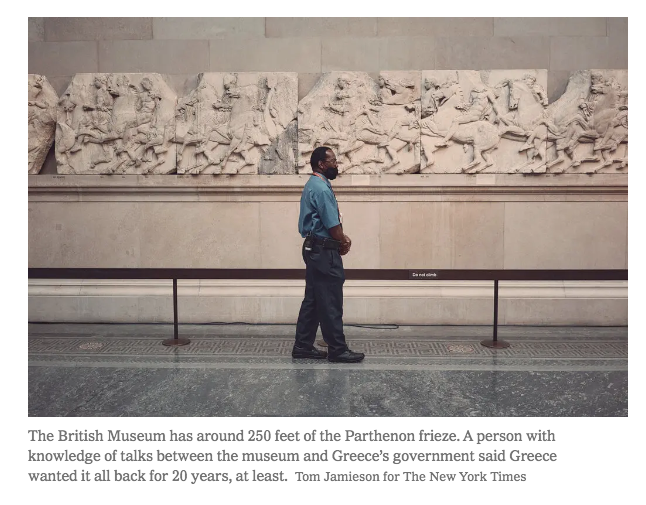
Ancient Athens can be found in the British Museum, thanks to (or curses to, depending on whose side one chooses) Scottish nobleman Thomas Bruce, seventh Earl of Elgin and 11th Earl of Kincardine. These priceless pieces of art and history are often called “the Elgin marbles.” You have likely seen this phrase in any number of Regency romances in which you have delved. In fact, in my Loving Lord Lindmore, (which goes on preorder in on February 5) my heroine wishes to view the Elgin marbles because her father was friends with Elgin and saw them while they were still stored in a warehouse in London.
The Elgin Marbles represent a chunk of history we rarely view. Those controversial, Elgin’s determination to bring the marbles to England likely saved them for posterity. The display has been called “the most visible restitution case in history.”

The New York Times tells us, “When Lord Elgin, a British aristocrat, sailed home from Greece in the early 1800s, he also shipped to England some of the greatest treasures of antiquity: a collection that included statues of Greek gods and carved frieze panels depicting battling centaurs that once decorated the Parthenon in Athens.
“Torn in some cases from the temple walls, ostensibly with the permission of the Ottomans who then ruled Greece, the so-called Elgin Marbles were later sold to the British government and became some of the most storied artifacts in the collection of the British Museum. But they also became, almost from the very day they were removed, the subject of perhaps the world’s most notorious cultural dispute.
“Since the days of Lord Byron, the romantic poet who was an early critic of their removal, the fate of the marbles has been bitterly contested. The British say the marbles were legally acquired and are best shown alongside other artifacts in a universal museum, while the Greeks view them as looted treasures that are a foundation of their national heritage.”
The Elgin Marbles, or Parthenon Sculptures, left Athens in 1801. Later, in 1816, they were sold to the British government. They were then and are now housed in the British Museum, which maintains the act to acquire the statues was a legal act of preservation. However, there is a growing push to return the pieces to Greece, but the British Museum has rejected all pleas to date.
Related Articles
Tony Blair Considered Loaning Parthenon Marbles to Greece to Boost Bid for London Olympics
Greece Offers to Trade ‘Most Important’ Artifacts for Parthenon Marbles
The Parthenon and the Acropolis have been “under attack” since the 400s B.C.E. But when Greece was overtaken by the Ottoman Empire, the situation became worse. In one battle, in 1687, a Venetian cannon mortar struck the monument, causing the roof to collapse, though the pediments were spared.

“British press publicized the vulnerability of the monument—“It is to be regretted that so much admirable sculpture as is still extant about this fabric should be all likely to perish from ignorant contempt,” the English antiquarian Richard Chandler wrote in 1770—encouraging western travelers to pillage its treasures in the interest of preservation. Their legal justification was tacit approval from Ottoman authorities.” The New York Times
Thomas Bruce, at one time served as ambassador to Greece, so he was familiar with the destruction. While Napoleon was attempting to conquer Egypt, Bruce was sent back to Greece to “beef up” Britain’s relationship with the Ottoman sultan Selim III. Part of his charge had been to make casts of the monuments.”[H]he brought with him a team of British artists led by painter Giovanni Battista Lusieri. But by then, it was difficult to approach the Parthenon and Ottoman troops demanded hefty daily payments for access. Already strapped for funds, Elgin directly appealed to the sultan for a firmen, or special permission, for his project to commence.
“On July 6, 1801, the sultan issued the following firmen: ‘When they wish to take away some pieces of stone with old inscriptions and figures, no opposition be made.’ Elgin interpreted this to mean he and his team could not only create copies of the monument but dismantle and export any pieces of interest.
“Elgin’s team removed 15 metopes, and 247 feet, or around half of the surviving frieze, including a female sculpture from the portico of Erechtheion and four fragments from a smaller temple to Athena Nike also located on the Acropolis. In 1803, the collection was loaded into some two hundred boxes and transported via the port of Piraeus to England.” [NYT]
Elgin intended to reconstruct part of the Parthenon, but Antonio Canova, the man charged with the task, refused, saying “it would be a sacrilege for any man to touch them with a chisel.”

One of the biggest critics of this venture was the poet Lord Byron, whose narrative poem Childe Harold’s Pilgrimage decried British imperialism, and called the removal of the marbles the “last poor plunder.” Byron alludes to Elgin in his annotations of the poem with epithets like “spoiler,” “robber,” and “violator.” However, we must preface this criticism by saying, during his tour of the Mediterranean in 1809, Byron visited Greece for the first time and immediately fell in love with the country. After meeting Ali Pasha, the Ottoman ruler at the time, the poet traveled throughout the country and visited all the monuments of Greek civilization. At the same time, Byron fell in love with the daughter of the British consul, Theodoros Makris and dedicated his famous poem “Daughter of Athens,” written in 1809, to her.
He remained in Greece for another ten months, following various adventures such as swimming in the Straits of the Hellespont (better-known as the Dardanelles), imitating the feat of the ancient Greek hero Leander.
Byron, always an avid supporter of liberal causes and national independence, supported the Greek war for independence. He joined the cause in Greece, training troops in the town of Missolonghi, where he died just after his 36th birthday.
See Related Article: Lord Byron remembered as a great philhellene
ARTNews tells us, “However, not all were moved by the poet’s protests: enormous crowds flocked to see the marbles in 1807 when Elgin installed them in a house near Piccadilly in London. Public interest prompted the British government to consider Elgin’s offer to sell the marbles to the national collection. Despite his titles, Elgin was in serious financial straits after personally covering the cost of shipping the sculptures to England. Including bribes for safe passage, the total price was £74,000—equal to more than $1 million today. In 1816, Parliament created a commission to assess Elgin’s offer that priced the marbles at £35,000. The sale was approved by a margin of two votes.
“In 1832, the marbles were relocated to the Elgin Room in the British Museum—the same year Greece won independence from the Ottoman Empire. Successive Greek governments have petitioned for the return of the works. In the 1980s, the government formally asked the British Museum to repatriate the marbles, citing the fact that authorization was given for their removal by an occupying empire, not the Greek government.”
Although there has been some talk in recent years of returning the Marbles to Greece, art experts have argued against doing so because of leaks in the galleries in Greece, though there was some question of “dubious conditions” in the British Museum in 2021. After Italy returned a fragment of the Parthenon to Greece in 2020, the talk has not settled. Moreover, Britain would like to host the Olympics again and would require Greece’s “goodwill” to do so. You may read more on the recent talks HERE.
BOOK BLURB...
LADY CORA TAKES SOCIETY BY STORM . . .
Lady Cora Midland, a highly-spirited country beauty, offers no pretensions, which win her many admirers, despite her lack of knowledge on how to manage the beau monde. However, Matthew Harrington believes she is taking advantage of his elderly grandmother, and he means to put a stop to the girl’s manipulations.
LORD MATTHEW LINDMORE IS IN DENIAL . . .
Despite objections, Lindmore reluctantly assists his grandmother in bringing Lady Cora out in Society. Yet, what appeared to be a daunting task becomes a transformation the earl does not expect. He finds the woman as delightful as do others in the haut ton.
Yet… When Lady Cora is on the the verge of marrying another, Lindmore fears time will expire before he can speak his own proposal.

Loving Lord Lindmore will release on February 21, 2024. Purchase links are below.
Will Be Available to Read on Kindle Unlimited
To Enter the Giveaway for an eBook copy of the book, leave a comment below. Winners will be chosen the weekend of February 17, and prizes will be delivered on February 21, 2024, the book’s release date.


Leave a Reply to Regina JeffersCancel reply