
Merry Christmas, Hannukah, Kwanza, Diwali, solstice, and winter! Since my post falls on Christmas day, I thought I’d take a peek at the history of Christmas trees.
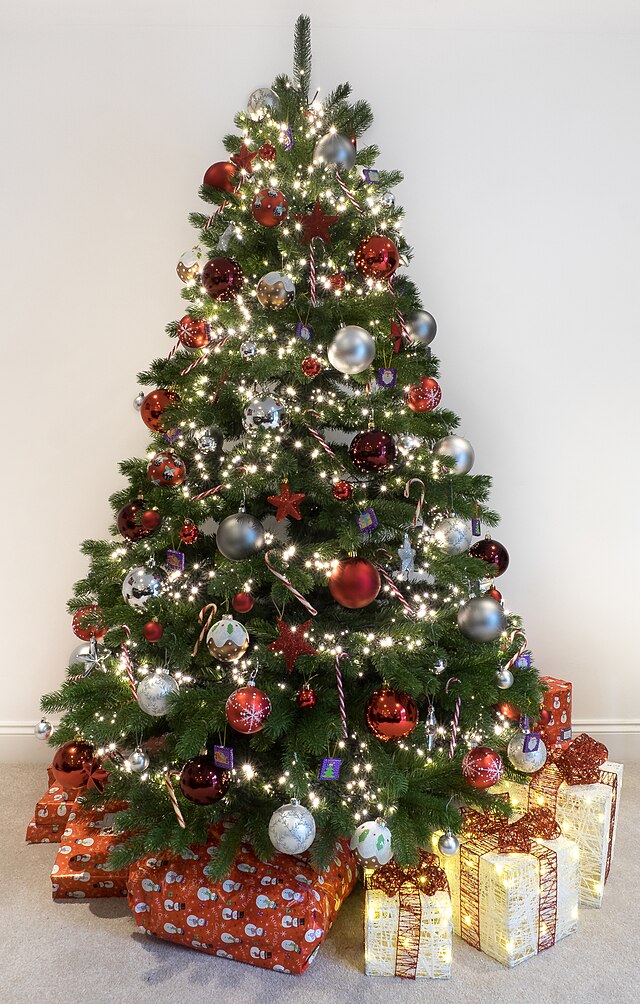
Here’s ours. At one point it seemed like we were done decorating, as every branch was already weighted by three ornaments, but we persevered and added more—because we are not quitters.

Somewhere on there is Ol’ Peg Leg, a gingerbread man who looks like his leg has been bitten off. (Why does it look like that? I try not to think about it.) Every year I suggest that maybe that little guy should hobble his way to that big cookie jar in the sky, but every year he hobbles onto the tree instead. This is in the spirit of our Christmas tree tradition of Never Throwing Anything Away–and now for a peek into the origins of the tree tradition itself.
How the Christmas Tree Tradition Started
The Christmas tree tradition started in Germany in the 1500s, when Christians started to decorate trees in their homes. Others created wooden pyramids decorated with evergreen branches as a less expensive version. According to legend, the idea to add candles came from Martin Luther, the father of Protestantism, who was inspired by the beauty of the nighttime stars. Soon people followed his lead, and Luther’s candle idea spread faster than a flame to dead pine needles.
The Tradition Spreads to the U.S.
It took a while for the Christmas tree tradition to travel to the U.S., mostly because Puritans objected to their houses burning to the ground while they slept. Just kidding. No one actually objected to this, except insurance companies in 1908, who said they were done covering fires started by Christmas trees.
Instead, the Puritans rejected Christmas trees as pagan. They felt that Christmas was so sacred that it could only be marked by a solemn church service, and they punished anyone who decorated or celebrated. (This was in the early days of the U.S., before we realized how lucrative plastic stars and dancing Santas are.) The Puritans later viewed all of Christmas as pagan and banned it, fining people the equivalent of $50 for celebrating or feasting, so for some years Christmas was actually illegal in the Massachusetts colony. The law, which lasted from 1659-1681, was repealed under pressure from England. (Thanks, England.)
It was in the 1700s, when Irish and German immigrants arrived, that the Puritans’ solemn views of Christmas started to dissipate, and Christmas trees began to pop up in people’s homes. They still were not widely popular, however. The tradition didn’t catch on until 1846, when a London newspaper included a sketch of England’s Queen Victoria and her German prince, Albert, standing with their children near their Christmas tree. This was the magic moment when Americans’ frothing obsession with British royalty caused the U.S. Christmas tree tradition to take root.

In the spirit of uncomfortable voyeurism, here is the royal tree for 2023.

It’s very similar to mine, except that the royal children haven’t snacked on any of the ornaments.
Christmas Trees Across the World
From Germany and England, the Christmas tree tradition spread across the world. Below are some tree traditions from around the globe.
In Ukraine, a spider web on the tree is considered good luck, thanks to the story of the Christmas Spider. According to the tale, a poor family who could not afford ornaments woke one morning to find their tree decorated with a beautiful, silvery web. This story is also the origin of tinsel being used as a decoration around the world.

In Guatemala, the Nacimiento, or Nativity scene, is the most popular decoration, but because of a large German population, the Christmas tree has joined the Nativity scene in many households.
Since 1947, Norway has given England a tree every year as a thank you for their help in WWII. The tree is displayed in Trafalgar Square in London.
Canada also has Germans to thank for their Christmas tree tradition. German immigrants to the U.S. migrated north and brought the tradition there.
The first Christmas tree may not have come from Germany but from Latvia or Estonia. Both countries lay claim to starting the tradition in the 13th or 14th century.
Japanese trees are often decorated with handmade origami birds.
In India, where spruce trees are scarce, people sometimes decorate mango or banana trees. In Uganda, they decorate palm trees and mango trees.
In Australia, where Christmas falls during a summer month, people decorate with seashells for a summery theme.
Did Jane Austen Have a Christmas Tree?
When I first started researching this question, I thought the answer was a definite “no.” But then I stumbled onto a record left by Emma Austen Leigh, Jane’s niece. In 1818, Leigh made a list of all the gifts she’d received, noting that they were left “BY THE TREE” (overzealous emphasis mine). This changes the answer to an absolute and definitive “maybe.”
Oh, and that problem of candles burning the house down? It was solved by some of Thomas Edison’s assistants, who thought up the idea of electric lights for trees in 1882, and also by Albert Sadacca, who marketed them and made them affordable in 1917.
Wishing you a very happy holiday season in whatever way you celebrate! Our holiday tradition is to put every ornament the children have ever made on the tree, even if that ornament doubled as a meal. What are your holiday traditions? I’d love to hear them!
Here are some of my sources:
Christmas at Windsor Castle! (for photo credit)
Did Jane Austen Have a Christmas Tree?
The History of the Christmas Tree Goes Back Farther Than You Might Realize
Who Invented Electric Christmas Lights?
Global traditions from this site and this one


Leave a Reply