
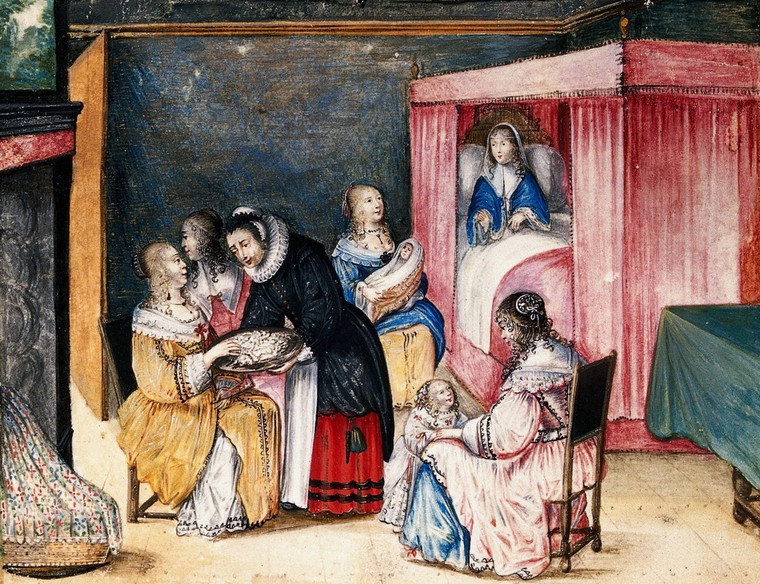
Giving birth was high risk in Austen’s day, claiming the lives of approximately one in 18 women. Four of Austen’s sisters-in-law died childbirth. (Did this have anything to do with Austen’s decision not to marry? Some scholars say yes.) This month, let’s explore childbirth in Regency England (and then feel very grateful for modern medicine).
Was there birth control?
This site is ending, so I moved this post. Read the rest of it here. (Forceps, Regency birth control, and celebrity endorsement of anesthesia in the birthing room still to come.)
I have loved writing this blog. Thank you, Regina, fellow Always Austen authors, and readers!

11 responses to “Regency Childbirth”
When you read articles like this you realise just how dangerous life could be in those days. Modern medicine and hygiene are amazing.
I was lucky with both my children as I had easy births. With my first I woke at 6.30 and went to the loo (where apparently my waters broke!) I was getting pains every ten minutes but I’d been told contractions come every forty or so minutes to start so went back to bed. Still having pains at 7.45 so rang the hospital who said to go in. I got there about 8.15 and had my daughter at 9.05! With my son I was a week overdue at my antenatal appointment and felt I was about to burst so they kept me in. At 10.30 I had pain and at 11 they took me to the delivery suite (my waters broke on the way) my son was born at 12.25! So I never had pain relief or any intervention!
I know of many who did need both those and might not have survived without them.
I’m so sorry to hear this site is closing, pass on my thanks to Regina for organising it for so many years and to all the contributors.
That is so wonderful that you had fast births. My last two were also quick, and I was grateful. Afterwards, I remember someone commenting that I had such easy births! I said, “Hm. I had fast births…”
Thank you for your readership, Glynis!
Wow! Thank goodness for modern medicine! It sounds like women in that day and age really had it rough for childbirth! No pain relief or anything.
I think it must have been terrifying! We owe a debt of gratitude to those women.
I had a miscarriage early on. With the second birth, I had an ectopic pregnancy, which nearly killed me, for the physicians did not think to consider my stomach pains had something to do with pregnancy. Down to one tube after the other burst, I finally had my son. He was on the small side – spaghetti thin legs for he was nearly 7 weeks early, but he survived and now has 3 children of his own. Nothing like having one’s water burst in the middle of my theatre class, which quickly became marriage and family life. lol
Regina, those sound like very traumatic moments. I am glad to hear you are now a grandmother of three.
That must have been a good story for the students in your class!
Thanks for all you’ve done for this site.
Regina, sorry to hear of your (scary) difficulties with pregnancies. Good news with your son!
Nice essay. Sad commentary on human greed: doctors who invented forceps kept it a secret w/in family for a 100 years as competitive advantage in medical field.
Stories like that are depressing and so plentiful in history. Thanks for commenting, Collins.
I really appreciate your well-researched glimpse into childbearing during the Regency period. Those were certainty not the most ideal conditions. Yikes! If numerous women in my family had lost their lives in childbirth and I didn’t have a good midwife that I could trust, I may have opted for adoption.
It’s hard to believe that forceps are still being used in childbirth, albeit very rarely. My husband was pulled out in that manner. It still seems a bit savage to me.
I’m relieved that the Catholic Church now teaches much more reliable methods for child spacing. Before I was married, I had to do all the research myself, but now it is readily taught to men and women who desire more natural alternatives.
From personal experience, I believe that present-day midwives have surpassed nurses and doctors in their ability to effectively accompany women through pregnancy and childbirth. If I were still looking for an OB-GYN to support me during pregnancy, I would prefer someone who was also an experienced midwife.
It was a scary time! We are so lucky childbirth is less dangerous now–and lucky for those women who did it despite the danger.
Midwives are still such a great resource.
Thanks for commenting, Yvonne.