
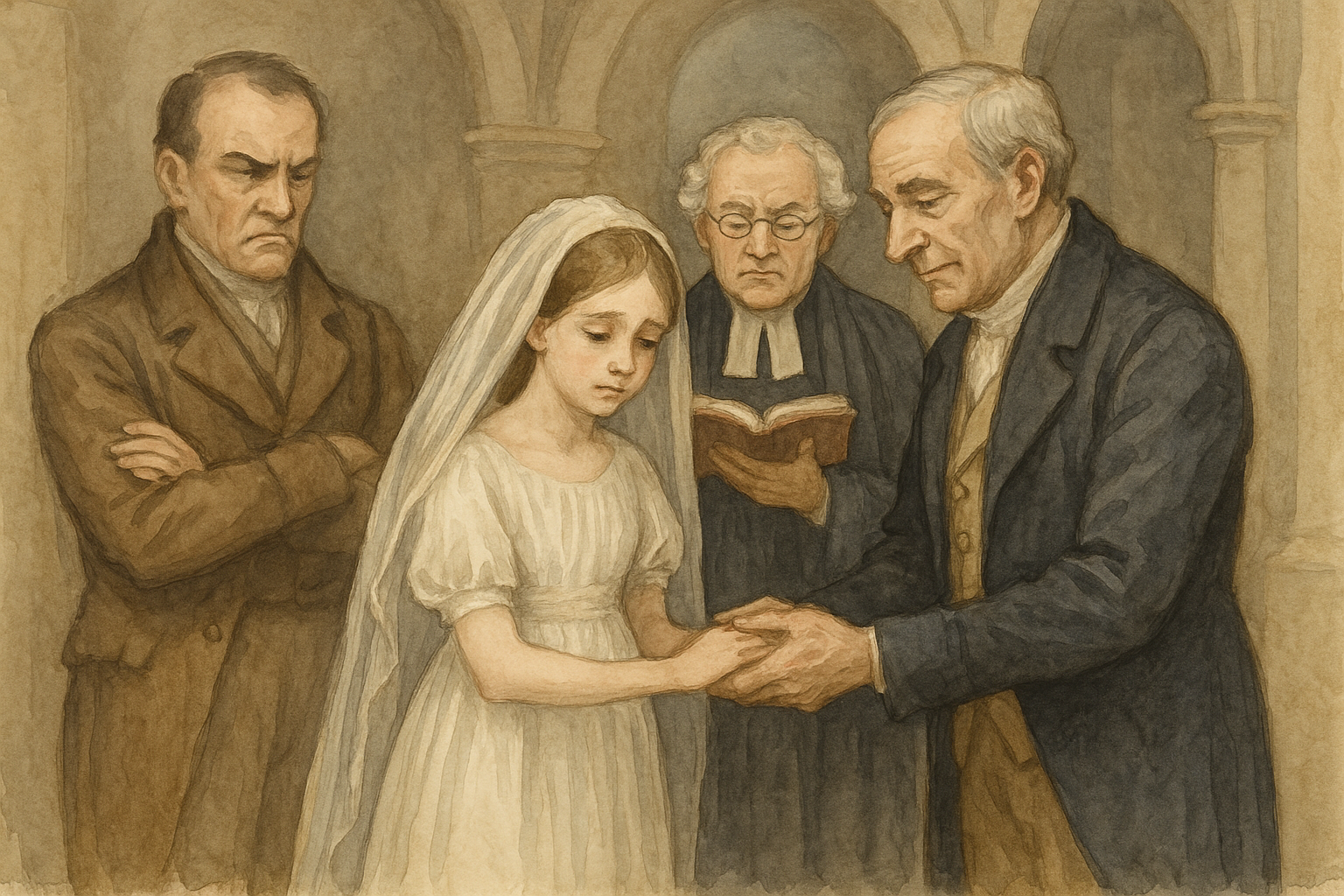
When people picture Regency England, they often imagine elegant ballrooms and whispered declarations of love. But for many young women, marriage was not a matter of choice at all. Arranged matches, family duty, and questions of property meant that girls—sometimes shockingly young—could be pressed into marriages they did not want.
Legal Framework
Under Lord Hardwicke’s Marriage Act of 1753, the law attempted to regulate marriage more tightly:
The minimum legal age was 12 for girls and 14 for boys. Below this, marriage was invalid.
Anyone under 21 required parental or guardian consent. Without it, a union was void in English law.
Clandestine marriages were curtailed: couples had to marry by banns read in church or obtain a license.
These measures helped prevent hasty or secret weddings, but they also gave parents and guardians enormous power over the lives of their children, especially daughters.
Arranged Marriages and Family Duty
For elite and wealthy families, marriage was as much about dynasty and property as affection. Alliances secured political influence, consolidated land, and preserved fortunes. A daughter’s hand in marriage could mean the continuation—or the ruin—of a family’s standing.
This meant that young women might be betrothed at an early age or strongly urged to accept a suitor chosen for them. The father, as legal guardian, had the final say until the daughter reached 21. While English law technically required the bride’s verbal consent at the altar, social and financial pressures could make refusal almost impossible.
Underage Brides
Although marriages of girls under 16 became less common by the early 19th century, they still occurred. Especially among landed gentry and nobility, wealthy heiresses were vulnerable to being married off young in order to secure estates or alliances before rivals could intervene.
A 15-year-old bride might be considered acceptable in certain circles, especially if she brought a fortune. While not the norm, such unions were tolerated—particularly if the match elevated the family’s prospects.
Theoretically, consent was required. At the marriage ceremony, the bride and groom had to answer the clergyman’s question affirmatively. But how freely was that consent given?
- Social coercion: A young woman might be told she was disobeying her parents, disgracing her family, or endangering her siblings’ futures if she refused.
- Financial dependence: Since unmarried daughters relied entirely on their fathers or guardians for support, defiance could mean destitution.
- Guardianship disputes: In cases where an heiress was orphaned, a guardian might seek to marry her advantageously—and sometimes to himself or his son.
For many, the choice was stark: obey, or face ruin and homelessness.
Resistance and Runaways
Some young women resisted. Elopements to Gretna Green, across the Scottish border where the age of consent was lower (16) and parental approval unnecessary, became notorious. While romanticized in novels, these flights could also be a means of escaping an unwanted arranged marriage.
Yet even here, coercion could play a role: heiresses were sometimes abducted or tricked into Scotland, then pressured to marry. Such cases blurred the line between consent and coercion, and families sometimes pursued annulments or legal battles to restore reputations and property rights.
The anxiety around forced and underage marriages found its way into popular literature. Gothic novels often featured heroines threatened with marriage to older, villainous men, heightening the sense of peril.
Jane Austen’s works—while less sensational—touch on the economic realities of arranged matches. Charlotte Lucas in Pride and Prejudice accepts Mr. Collins not for love, but to avoid the prospect of destitution. In Sense and Sensibility, Edward Ferrars is nearly trapped by a youthful engagement.
These stories reflected real concerns: young women caught between family duty and personal desire.
Changing Attitudes
By the Regency era, cultural ideals were slowly shifting. Companionate marriage—marriage for affection as well as advantage—was becoming fashionable in upper-class circles. The very novels young women read reinforced the notion that marriage ought to include mutual respect and choice.
1823 – Marriage Act Amendment
By the early 19th century, complaints had grown about irregularities in the solemnization of marriage. Clergymen sometimes disregarded the rules of banns or issued licenses improperly, leading to confusion over whether certain unions were valid. The Marriage Act Amendment of 1823 clarified these procedures, ensuring that banns were read correctly and that licenses followed strict protocols.
The goal was to prevent both mistakes and deliberate abuses, making it harder for forced or clandestine marriages to slip through legal loopholes. For Regency families, this reform reinforced the authority of the Church and courts in regulating unions.
1836 – Marriage Act
A more sweeping reform arrived with the Marriage Act of 1836, which broadened the very definition of a lawful marriage. Until this point, only ceremonies conducted within the Church of England were legally recognized, leaving Dissenters, Catholics, Jews, and others in a difficult position.
The 1836 Act introduced the option of civil marriage ceremonies and allowed recognized non-Anglican denominations to perform valid unions. While not directly about age or parental consent, this change marked a crucial step toward broadening marriage rights and reducing the state’s reliance on a single religious institution. It also provided more oversight and record-keeping, which indirectly strengthened protections for vulnerable brides.
Nevertheless, the shadow of coercion remained. Arranged marriages did not vanish overnight, and the vulnerability of underage women—particularly those with money—persisted.
True love matches certainly existed, but for others, the wedding ceremony was less a celebration than a surrender. For underage brides, especially heiresses, marriage could be not a choice freely made, but a destiny imposed by family will.


Leave a Reply