
As I’ve written before, I’ve spent a fair bit of time of late going through my mother-in-law’s apartment, clearing and organising and sorting through endless boxes as we’ve moved her into a seniors’ residence. The move is over, but the chaos is not.
Some things she kept, others we gave away, some we tossed, and some—a lot—we brought to our house.
And now the fun begins, as we start going through the massive quantity of old family documents. Photographs, deeds, letters, and various other documents all await. They’ve been sitting in boxes for decades, and we’ll start examining them slowly.
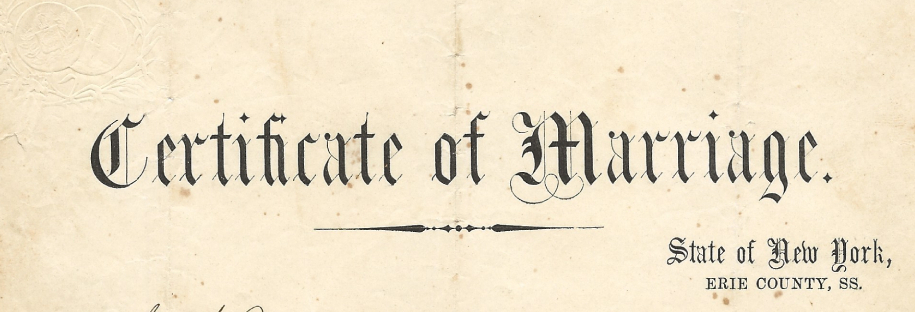
One of the more interesting things we discovered today is a marriage certificate from the mid-nineteenth century.

It reads (to the best of my transcription abilities):
Certificate of Marriage
State of New York
Erie County, SS.I, G.A. Waldron, Justice of the Peace, of the City of Buffalo, in said County, do hereby certify that on the 27th day of November, 1854, at the city of Buffalo, aforesaid, Freeman Swayze age 31 of Pellen, Canada West, and Berminia Botts age 14 of Brantford, C.W. were married by me; and that G.A. Waldron Jr and Selah Barnard… [paper is cut off at this point]
Well!
At first, I was awed at the age of the paper, in remarkably good shape despite the bottom section being missing. Then I began to look at the text.
Buffalo. Interesting. Why did two Canadians go to Buffalo, New York, to get married? Surely there were places closer to home. I kept going. This document, this very piece of fragile paper, has been floating around since 1854. That’s 170 years ago. Not exactly yesterday. Next I remarked on the name of the groom—Freeman—which was his mother’s maiden name if the family tree can be believed, and I puzzled over how a lad from Pellen (which I’m pretty sure is Pelham, where the family lived) and a lass from Brantford, nearly 60 miles away, met. And then…
And then I let out a rather unladylike expletive when I read the age of the bride.
Fourteen.
FOURTEEN!
A child. A babe in arms. Younger than Georgiana Darcy, even, or Lydia Bennet!
And then some pieces fell into place.
We kept digging. Things got a little confusing, but eventually we put together these pieces of information.
According to a family history written in 1910, and census data from 1851, Freeman was born on September 18, 1822, to a family well established in Pelham, Upper Canada. That must be the actual place that the Justice of the Peace misheard (or misspelled) as Pellem.
More digging through archives named Freeman’s wife as Jemima Potts, born in 1839. That certainly matched what the marriage certificate indicated. It seems that Justice Waldron was either a bit hard of hearing or just plain inattentive, given the misspelling of Pelham, so it’s more than conceivable that he misheard Jemima Potts as Berminia Botts. Berminia, apparently, was a not uncommon name at the time. Interestinger and interestinger.
The last few lines of the marriage certificate have long since crumbled into dust, but it looks like G.A. Waldron, Jr. and Selah Barnard were the witnesses, which suggests that none of the family were in attendance. That can only mean an elopement! Right?
There must be a story in there! I’m sure of it. But I still can’t get past the idea of a 31-year-old man eloping with a 14-year-old girl.
This is looking a lot like a George Wickham situation, isn’t it?
Here’s a story I’ve put together in my mind.

Freeman, dashing but roguish at 31, was thrown into company with a coquettish lass, who swished her skirts and batted her lashes at him, looking and acting older than her tender 14 years. I imagine Lydia Bennet prancing around a ballroom, stealing officers’ swords and revealing a well-developed bosom, flirting with everything in pants.
He ignores her at first, but her charms cannot be denied, and soon enough their mutual attraction cannot be denied. She is charmed by his maturity and sophistication; he by her high spirits and exuberant youth.
But a gap of seventeen years is too much for her family to sanction—Freeman, after all, is more than twice her age—and they separate the lovers. Jemima is dragged back to Brantford in tears and Freeman sulks back to Pelham. Still, true love, or whatever passes for such between such an unlikely pair, is too strong for parental displeasure to conquer, and the two write secretly, concocting a cunning plan. Under cover of night, Freeman makes his way to Jemima’s home and helps her escape, probably using a ladder of tied sheets from an upstairs window, because that’s how it happens in paintngs and novels, and the two abscond across the border, not to Scotland, but to New York, where a hard-of-hearing JP pronounces them Man and Wife.

A bit sordid, but nothing unusual. Right?
But wait! There’s more.
We did more research. Finding Freeman Swayze was easy enough in the archives and census data we’ve found, and the sources are fairly consistent. His family had settled in Pelham in the 1810s and farmed the land. His father was considered a pious man of his time, and Freeman was set to follow in his family’s agrarian ways.
So not, perhaps, the libertine throwing money around to capture a young girl’s immature heart.
It was less easy to find Jemima Potts. Or Botts. Or Pots. Consistent spelling, it seems, is a modern affectation, and in our digging we found more than four ways of spelling Swayze. But eventually we did come across our erstwhile heroine. Jemima Pots (according to the census we found, most likely incorrectly spelled) was, indeed, born in 1839 near Brantford, but at age 12, she was not a starry-eyed Juliet, hanging out on balconies waiting to be eloped with, but rather, she was a servant, living with another family.
I’m not sure what bothers me more. A 14-year-old bride, or a 12-year-old live-in servant.
Then we discovered that despite the rush to the altar in another country, the couple’s first child was not born until five years after their marriage. One would imagine that after an elopement, there would be plenty of, ahem, opportunities to be fruitful and multiply. But five years is quite a delay, especially when we learned that she eventually had eight or nine children. Infertility was not a problem.
And so, another picture starts emerging. This is just as fanciful as the first, but it paints a less scandalous picture. Let’s see how this goes.

Jemima Potts, from a poor family of farmers near Brantford, is forced by circumstances to take a position as a scullery maid or laundry assistant or something to the Gillesby family. Servants are not known to be generally well-treated, and who knows what abuses poor Jemmy had to endure. Whippings, little sleep, endless dangerous tasks, constant screaming and shouting… I could be entirely wrong and the Gillesby family might have been lovely. But my version makes a more interesting story.
On one of her tasks, young Jemmy is sent to help carry the harvest to a market, where she is noticed by a young man there for his own business. He offers to help her with her load, and he discovers her plight. His heart is touched by her predicament.
They meet again and again at various markets, and each time he feels more and more sympathy for the girl, who seems to be destined for a lifetime of misery and abuse. She is sweet and so very sad, and he is desperate to find a way to help.
Eventually an idea comes to him. If they marry, he can rescue her from her terrible position.

Now I imagine that same escape, but this time he steals her away from under the master’s crop as he threatens to whip her again for not peeling the carrots evenly enough.
“You can never escape!” the cruel master shouts. “Servants have no rights to leave employment. I’ll have mine!”
“Never!” Freeman strides into the room, shielding the now-14-year-old with his body. She’s coming with me.”
He glances to Jemima, who returns his look with a timid but hopeful nod, and together they leap onto his waiting horse and flee out into the countryside. As a married woman, Jemima is safe from her former employers. Freeman will take care of her, and will treat her with all due consideration until she’s old enough to take her full role as his wife!
Okay, that’s laying it on a little thick. But there might be something of what happened in there, based on the sources we found.
Jemima Swayze, nee Potts, died in 1889. One of her children was my husband’s great-grandfather, born in 1866. As for Freeman, he made enough of himself that a street is named after him in Niagara Falls. When he died at the age of 86, his occupation was listed as ‘Gentleman’. So perhaps not a vile George Wickham-by-another name after all.
I wonder what other stories we’ll find as we continue to sort through our boxes and boxes of documents and photographs.


Leave a Reply